Professional Book Study Blog #5


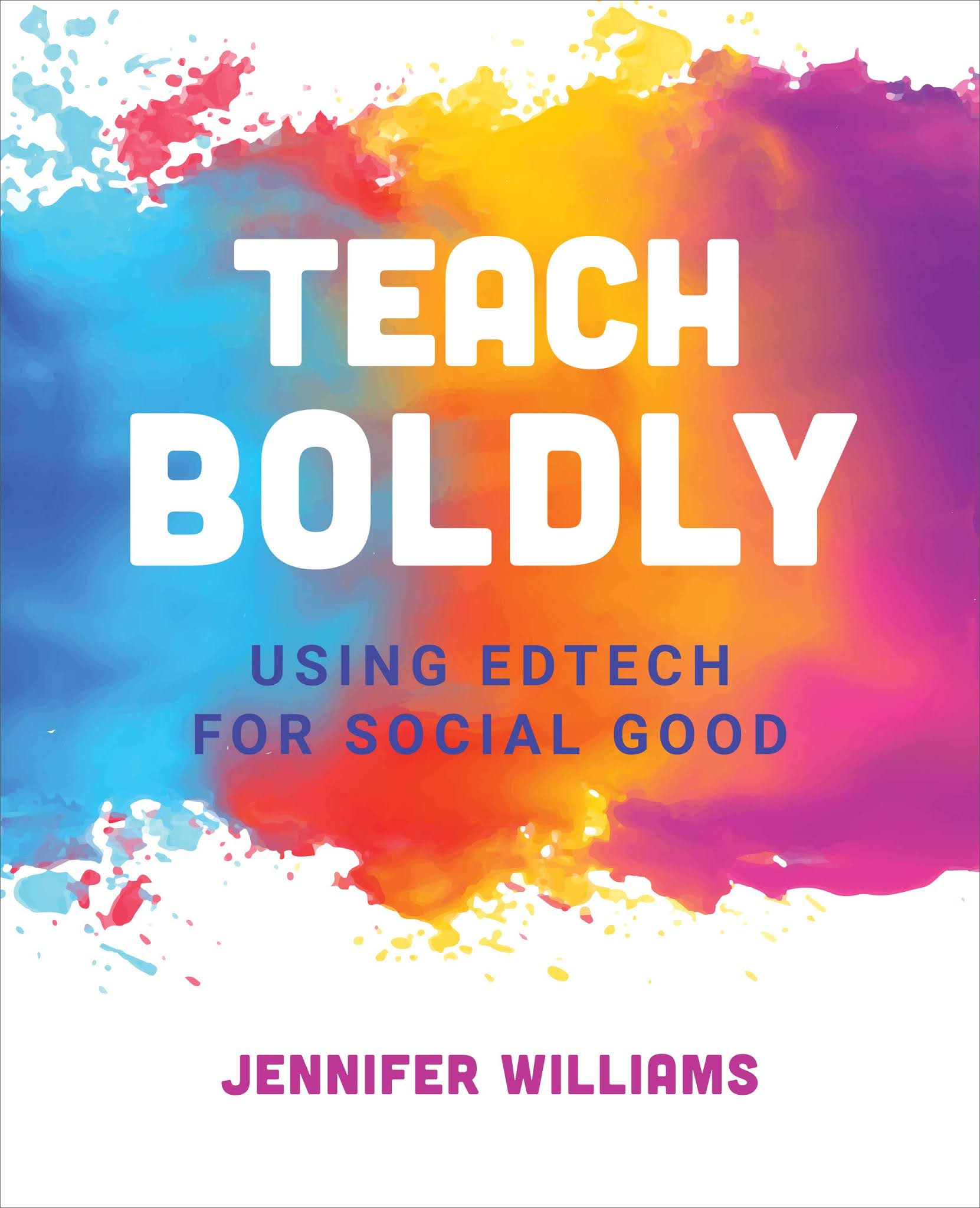
For this blog, I was tasked with reading a book entitled Teach Boldly by Jennifer Williams. This was not my first choice for books, but I was interested in getting some ideas after reading the description. In my opinion, the book centered around the themes of social justice and equity in education. Williams goes into detail about how to achieve these things through using educational technology. I enjoyed the different examples of what she had been introduced to. In particular, Chapter 3 is titled The Human-Centered Learning Environment. This chapter described a plan created after Google did a diversity analysis within their own company. They realized that their company was not as diverse as they thought and they wanted to help change that. To tackle the problem, they decided that they needed to start at the beginning -- in schools. This was the birth of the Google Code Next lab in Oakland, California. It was centrally located in a diverse neighborhood and help students from local schools to begin using the lab. This idea is a great way to meet the students where they are. It has become all too noticeable with the current pandemic as to how many students across the country do not have the same opportunities due to socioeconomic status. 

I love this video about equity by an educator.  

With equity issue becoming more apparent, we are the ones that are going to have to start where we can in our own classrooms. I know that within my own district, we have tried to bridge some of the gap with devices and hotspots for those that do not have internet service at home. We still must rely on companies to make sure their service is available in all areas, including rural areas. That is a major issue in my local district. We have places that cannot receive services due to the rural location of their homes. 

Throughout my career, I hope that we can continue to close these gaps and make our education system better for all students. 

We can use systems such as described in Weiler and Hinnant-Crawford's article. This is what they say, "Integrated Comprehensive Systems for Equity builds collaborative equity capacity and guides leaders, teachers, staff, students, and families across a school system using a “four cornerstones” framework: (1) Focus on equity, (2) Align all students and staff, (3) Transform teaching and learning, and (4) Leverage policy and funding toward equity. (p. 3)" 

Overall, the book was not the easiest read and definitely not my favorite professional development resource. I did enjoy the parts in each chapter that included ideas to try in my own classroom. It will be fun to use these ideas with my own students and connect globally while helping all of society to come together.


Williams, J. (2020). Teach boldly: using Edtech for social good. Hawker Brownlow Education.

Weiler, J. R., & Hinnant-Crawford, B. (2021). School Leadership Team Competence for Implementing Equity Systems Change: An Exploratory Study. The Urban Review: Issues and Ideas in Education, 1. https://doi-org.ezproxy.montevallo.edu/10.1007/s11256-021-00600-7


Comments

Popular posts from this blog

Student Records, Training, and Security

                      via GIPHY Who? How? Where? Great questions to ask about all the student data that has to be input, stored, and protected in schools today.  As the education system has moved to electronic records and data storage, some schools have had to make decisions about who, how, and where all the data will be stored. The best way to do all those things easily is to use a student information system (SIS). This varies in schools, districts, and states immensely. There are many SISs to choose from. Some schools may have the choice to use what they think is best, while others may have to use whatever their district office decides on. Others may be required to use a system that the whole state has established.  I know that in my district we have to use the state's choice of SIS. I feel like that is a good decision because some students may move schools and this helps with transferring records. We also had a recent c...

ED 610 Blog Reflection #2

Thinking back on this last year in education, it has been a crazy, mixed up experience for all. I was only in my first full year of teaching (I had started in the middle of the year before), when the Covid 19 pandemic shutdown happened. I don't follow much news and so, the whole thing came somewhat of a surprise to me. I was planning out the end of the year and just thinking about how to finish out the year. Like everyone else, my district shutdown very quickly with the intent to reopen in 3 weeks after our Spring Break. We all know that did not happen.  The district had to plan out a way to finish out the year in a big hurry. We had paper packets and gave out any device we could to accommodate. Students without internet access were provided with hotspots in hopes that they would work. The district had the infrastructure within the schools to provide access but the students did not have that at home. The reality of the socioeconomic differences throughout our district was made very...

Why do we give teachers tools if we do not take the time to train them how to use them?

I know how most teachers feel about professional development. Ugh! In my experience as a teacher, I've been given a lot of tools, software, devices, programs. You name it and I probably have a teacher account that my district has provided. What is lacking is the training in how to use all of them or even most of them. So many times, teachers are sent tutorial videos to watch on their own time when given something new to learn. Other times, teachers have to teach themselves or find videos online to learn things. Something that I have noticed is that training is given for things that teachers do not even use on a daily basis. We have to change this. As a future technology coordinator, I want to make it a mission to provide training for teachers often and make sure that it will actually be relevant. Teachers do not want to feel like their time is wasted on training for "nothing." This means that leaders need to get input from teachers on what they need and what will be the...